Tiered lecture halls require careful coordination between seating dimensions, floor levels, and student movement. Unlike flat classrooms, each row sits at a different height, which affects sightlines and the space available for writing surfaces. Choosing suitable furniture means considering how students enter their seats, use learning materials, and move between rows during busy class changes.
For universities, schools, and public training facilities, a lecture chair with table should match the room’s geometry and teaching activities. Fixed seating and folding-seat designs offer different advantages. The final choice depends on tier depth, row spacing, required capacity, and the amount of space available for circulation.
How Do Tier Dimensions Affect Seating Choices?
Row depth is one of the first measurements to verify. The available space must accommodate the chair, the writing surface, and sufficient clearance for the person seated behind. A layout that fits the furniture footprint may still feel cramped when students use their tables or move past occupied seats.
Tier height also influences visibility. Students in rear rows need a clear view of the presentation area without excessive obstruction from the people or furniture in front. Project teams should examine sightlines from several positions, including rear corners and aisle seats, rather than checking only the central viewing angle.
Floor construction matters during installation as well. Each tier must provide suitable fixing positions for the selected seating system. Buyers should confirm the relationship between chair bases, platform edges, steps, and handrails before finalizing the layout. These checks can help prevent installation conflicts and unexpected reductions in seating capacity.
Which Seat Mechanisms Suit Different Layouts?
Fixed seats suit lecture halls where furniture remains in a permanent arrangement. Their consistent positions make it easier to plan row alignment and maintain a defined seating pattern. However, the design must leave enough room for students to enter and exit without creating unnecessary obstruction in narrow passages.
Folding seats can help preserve circulation space when chairs are unoccupied. A tip-up mechanism allows the seat to return to an upright position, reducing its projection into the space behind. Buyers should check the folded and occupied positions because the available clearance changes during use.
The choice should reflect the actual operating schedule. Halls hosting several classes each day may benefit from a mechanism that is straightforward to inspect and maintain. Facilities teams should review seat movement, potential contact with adjacent furniture, and access to replacement components before approving a model for large-scale installation.
What Should Buyers Consider When Sizing Tablet Surfaces?
Writing surfaces must accommodate the materials used during lessons. Students may need room for notebooks, printed handouts, pens, or portable computers. Procurement teams should consult teaching staff about typical activities before selecting tabletop dimensions.
A lecture chair with table should provide usable space without extending too far into the next row. The tabletop width, projection, and mounting position should be checked against the tier plan. Testing a sample with common learning materials can reveal whether the surface is practical for extended note-taking.
Surface materials also affect daily maintenance. Buyers should examine the finish, edges, attachment points, and recommended cleaning procedures. Laminated surfaces may suit routine institutional use, but the complete assembly still requires appropriate care. The selected design should allow maintenance staff to inspect the tabletop and its supporting components without unnecessary difficulty.
How Do Materials Influence Long-Term Use?
Busy educational facilities place repeated demands on seat mechanisms, table attachments, and structural components. Maintenance plans should cover loose fasteners, damaged finishes, unusual operating noise, and changes in seat movement. Recording recurring faults can help facilities teams identify components that need adjustment or replacement.
Backrest materials should be selected according to the institution’s budget, appearance requirements, and maintenance practices. Wooden and upholstered options offer different finishes and care requirements. Buyers should review the complete configuration rather than assuming that one material is suitable for every lecture hall.
These considerations also help procurement teams compare suppliers on practical grounds. Clear specifications for dimensions, materials, fixing methods, and available accessories make quotations easier to evaluate. Consistent documentation is particularly useful when a project involves multiple halls or several installation phases.
Where Does the Hudson L-E06 Fit?
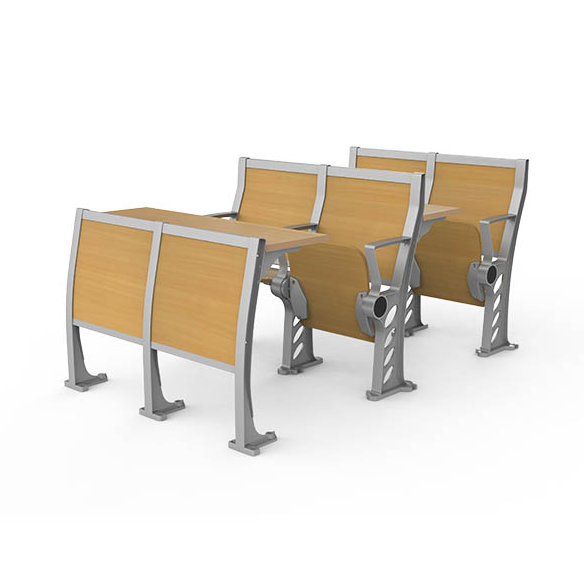
Once the layout requirements have been established, buyers can compare individual seating models against the approved specifications. Leadcom seating offers the Hudson L-E06 for educational facilities, including universities and high schools. Its configuration combines a laminated particle-board tabletop with laminated plywood for the back, seat, and modesty panel.
The model uses a counterweight tip-up seat mechanism. Its legs and arms are made from die-cast aluminum with a powder-coated finish. Buyers can choose a wooden or upholstered back according to the facility’s budget and requirements. A book rack is also available, so its inclusion should be confirmed when reviewing the order.
These features provide several points for technical evaluation, but the room layout must guide the final decision. Project teams should confirm the model’s dimensions, mounting details, tabletop clearance, and compatibility with the specified tier geometry before approving it for installation.
What Should Be Verified Before Ordering?
Before bulk procurement, compare the furniture drawings with the latest architectural plans. Confirm row pitch, seat width, tabletop projection, tier rise, aisle clearance, and distances from walls and handrails. Review the front, middle, and rear sections separately because available space and sightlines may vary across the hall.
A sample installation can help validate the proposed arrangement. Test the seat in both occupied and folded positions, assess the writing surface with typical learning materials, and check visibility from representative seats. The installation contractor should also confirm that the proposed floor fixings suit the platform construction.
For projects involving multiple buildings, document the approved model, materials, accessories, and installation requirements. This reduces the risk of inconsistent configurations between halls and makes later maintenance easier to organize.
Select Seating Around the Complete Layout
The most suitable chair type depends on the hall’s tier dimensions, teaching activities, and circulation requirements. Fixed seats can support permanent arrangements, while folding mechanisms may help preserve passage space. Writing surfaces should be sized for practical use without compromising the clearance needed between rows.
When comparing a lecture chair with table, buyers should evaluate the complete seated arrangement rather than the furniture in isolation. Leadcom seating and its Hudson L-E06 model can be included in that assessment, provided the selected configuration matches the project drawings, installation conditions, and operational requirements.