Electric vehicle thermal management no longer revolves around a single engine cooling loop. Motors, inverters, onboard chargers, and heat-pump assemblies can operate within different thermal windows, creating several independent or interconnected coolant circuits inside the same vehicle.
Because polymer tubing can combine low mass, routing flexibility, and resistance to automotive fluids, nylon tube extrusion is increasingly relevant to these layouts. DEKUMA develops multilayer nylon tube extrusion technology that can be configured around different material combinations, giving engineers another option when conventional metal or single-layer tubing does not suit a compact EV package.
Different Heat Loads Across EV Cooling Circuits
Motor cooling circuits can experience substantial heat generation during sustained acceleration, towing, climbing, or high-speed operation. The coolant temperature and flow requirements may consequently differ from those found around less thermally demanding components. Hose and tube specifications need to account not only for peak temperature but also for repeated transitions between high-load and low-load conditions.
Inverter cooling introduces another consideration: electronic power components can be sensitive to temperature fluctuations even though their physical size is relatively small. Stable coolant circulation helps transfer heat away from semiconductor devices and associated hardware. Tube placement may involve narrow spaces around electrical components, making bend radius, connector positioning, and insulation considerations relevant during system design.
Onboard chargers and DC/DC converters add yet another thermal zone. Their cooling requirements depend on electrical load, charging duration, ambient conditions, and the architecture of the vehicle’s thermal-management system. Nylon extrusion can be considered for selected fluid paths where chemical resistance, dimensional control, and packaging flexibility are required, provided that the polymer structure matches the coolant and operating conditions.
Material Layers and Coolant Compatibility
EV coolant circuits may use water-glycol mixtures or other formulations developed for modern thermal-management systems. Additives intended to control corrosion, biological growth, or material compatibility can interact differently with polymers than conventional engine coolants. Long-duration immersion testing is useful because short-term exposure may not reveal dimensional change, swelling, extraction, or gradual property loss.
Multilayer tubing provides a way to assign different functions to different parts of the wall. A mechanically durable outer layer can coexist with an inner material selected for coolant contact, while an intermediate layer can provide bonding or barrier characteristics. The final construction depends on permeability targets, pressure, temperature, flexibility, and the required connection method.
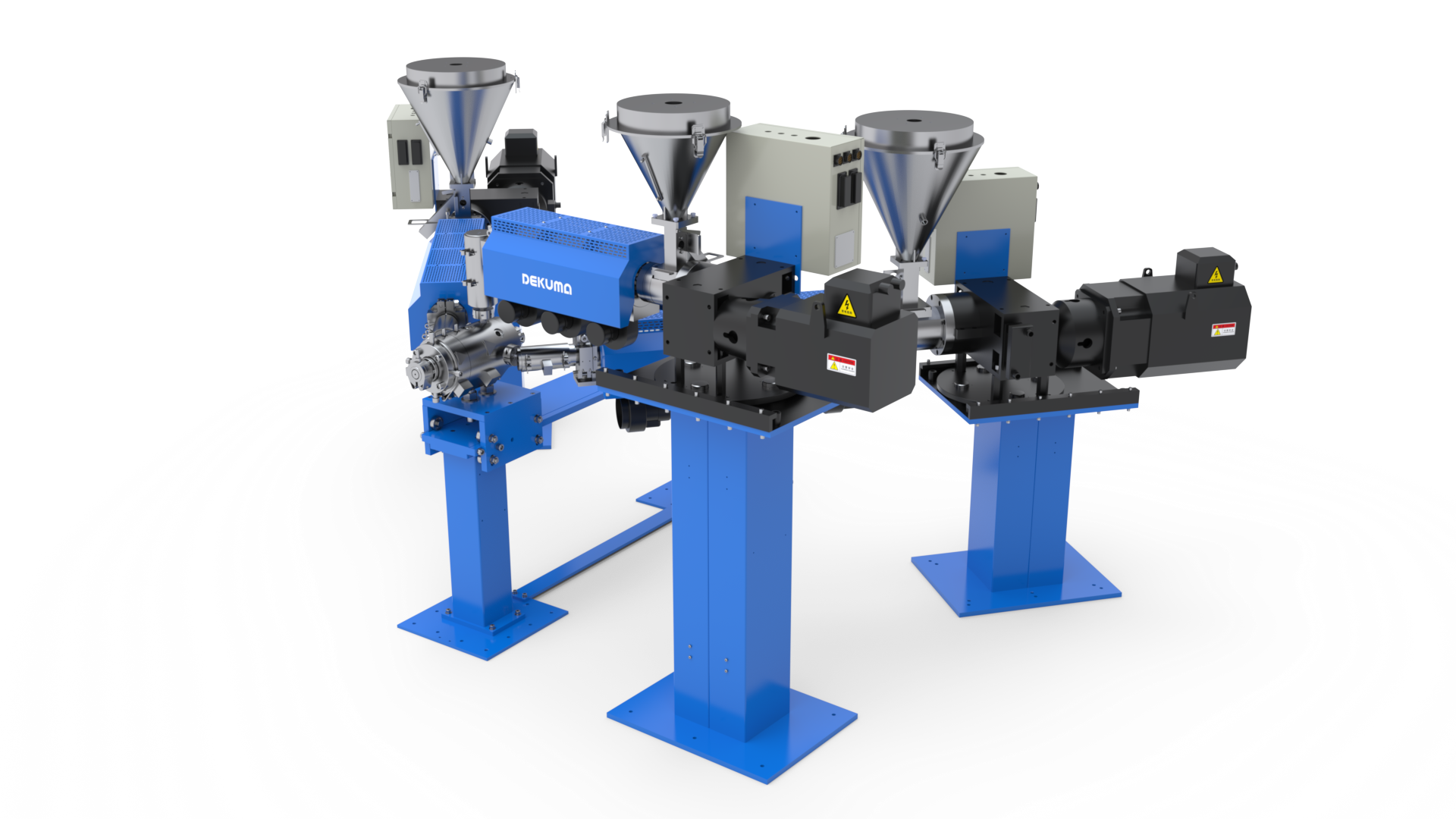
DEKUMA‘s Multi-layer Nylon Composite Tube Extrusion Line uses three extruders for separate outer, middle, and inner layers. Each extrusion unit uses a servo motor, with a maximum listed extrusion output of 50 kg/h for the combination. Its specialized spiral die head uses mould steel with a tempered flow-channel surface, ceramic heating, a maximum listed temperature of 300°C, and an adjustable die-to-core gap. The core can also be changed to accommodate production requirements, providing a practical configuration for multilayer tube development.
Routing Constraints Inside Electric Powertrains
EV packaging often places thermal components close to one another, leaving limited space for fluid lines. A tube may need to pass around battery structures, electrical housings, pumps, valves, and chassis components while maintaining an acceptable bend radius. Excessive bending can increase local stress, whereas a tube that is too rigid may transmit unwanted loads to its fittings.
Vibration is another factor that changes according to location. An inverter-mounted circuit may experience a different mechanical environment from a line attached to the vehicle body. Pump pulsation, road vibration, thermal expansion, and movement between connected assemblies can all contribute to fatigue. Tube specifications consequently need to consider the entire routing path rather than evaluating a straight section in isolation.
Connection design can be equally important. Compact EV circuits frequently use quick connectors, molded ports, clamps, or specialized fittings. Dimensional consistency at the tube interface affects assembly quality and retention. Nylon tube extrusion provides a means of producing controlled tube geometry, but connector compatibility, bend performance, pressure cycling, and thermal ageing still require validation at the system level.
Matching Tube Qualification to EV Duty Cycles
Traditional ICE cooling systems provide useful reference data, but EV qualification cannot simply copy every assumption from engine coolant applications. The absence of an internal-combustion engine does not mean thermal exposure becomes simpler. Continuous operation of electric drive components, repeated fast charging, regenerative braking, and active cabin conditioning can produce distinct duty cycles.
Testing can be structured around realistic combinations of temperature, pressure, coolant chemistry, and flow. Thermal cycling may be paired with pressure pulses, while immersion tests can assess long-term material interaction with the selected coolant. Flex-fatigue testing becomes particularly relevant where tubes cross moving interfaces or occupy tight bends.
Production control must support the same material consistency demonstrated during validation. DEKUMA’s line incorporates controlled layer extrusion, servo-driven material handling, and an adjustable multilayer die arrangement, while ceramic heating supports thermal regulation around the die. Such features can help maintain a defined process window, but the appropriate settings depend on the resin grades, layer ratios, tube dimensions, and coolant system under development.
Conclusion
EV powertrain cooling has created fluid-routing requirements that are more varied than a conventional engine-centric architecture. Motor and inverter circuits may face different heat loads from onboard charger or heat-pump connections, while packaging restrictions can place unusual demands on flexibility, dimensional accuracy, and connection behaviour. Nylon extrusion offers a useful manufacturing route for selected applications, particularly where multilayer construction can separate mechanical, chemical, and barrier functions.
DEKUMA’s three-extruder multilayer configuration, adjustable spiral die head, and controlled heating provide a concrete equipment framework for this type of development, while material testing and vehicle-specific qualification determine whether the resulting tube construction fits the intended EV cooling circuit.